
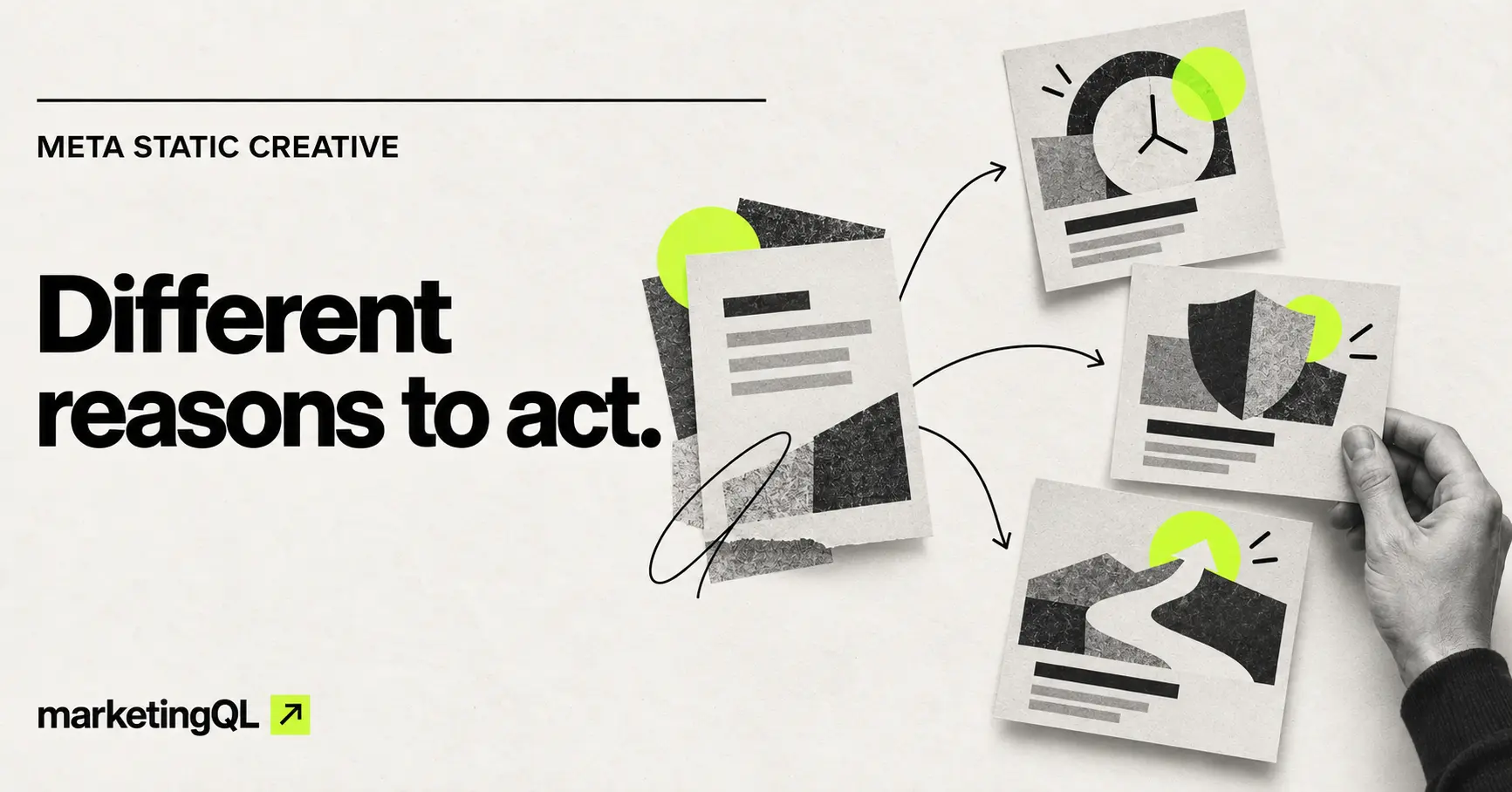
It is easy to make three Meta ads that look different in a design file but communicate the same reason to buy.
The background changes. The product moves from the left to the right. One headline is shorter. Those may be useful variations, but the campaign is still testing one basic idea.
I would start one level higher. Ask why the buyer should care about the offer in the first place. Then turn a few different answers into separate static-ad concepts.
Meta’s current Blueprint material describes creative diversification as varying formats, visuals, and messages, and it specifically teaches diversification by concept and motivator. For a static-only production queue, the format can stay fixed while the reason to act changes. That gives the design team a clearer assignment and gives the campaign a more useful first question.
A motivator is the reason the message matters
A product feature is not automatically a motivator.
“Automated reporting” is a feature. A marketing manager may care because it saves Friday afternoon, catches a pacing problem earlier, or makes the next budget meeting easier. Those are different reasons to pay attention to the same product.
I would separate four parts of the creative request:
01 / OFFER
What is available?
The product, service, guide, demo, or promotion the campaign is putting in front of the audience.
02 / MOTIVATOR
Why should this buyer care?
The practical or emotional reason the offer matters now, such as saving time, reducing risk, or making a decision easier.
03 / CONCEPT
How will the ad express it?
The organizing visual idea that turns the motivator into something a person can understand quickly in the feed.
04 / VARIATION
What smaller detail changes?
A different headline, crop, proof point, image choice, or layout inside the same concept.
This distinction matters because each layer answers a different question. A motivator test asks which reason resonates. A concept test asks which way of expressing that reason works. A variation test asks how to improve an idea that is already worth developing.
One offer can support several honest reasons to act
Here is a hypothetical example for a paid-media reporting product. It is an illustration, not a client campaign or a performance claim.
The audience is an in-house marketing manager. The offer is a product demo. The product helps organize campaign reporting, but the first round does not repeat that same feature three times.
HYPOTHETICAL META STATIC-AD EXAMPLE
One offer, three buyer motivators
Offer: See a paid-media reporting workspace in a product demo.
Save time
Headline: Stop rebuilding the weekly report.
Visual direction: A finished report replacing a stack of scattered exports.
What it tests: Whether reducing repetitive work is the strongest reason to take the next step.
Reduce risk
Headline: Catch pacing problems before Friday.
Visual direction: One problem row is flagged inside an otherwise clean budget view.
What it tests: Whether earlier visibility into a problem is more compelling than time savings.
Explain results
Headline: Walk into the budget meeting ready.
Visual direction: A clear summary moving toward a simple presentation frame.
What it tests: Whether confidence in the next internal conversation is the more useful promise.
The product and next action stay the same. The reason to care, headline, and visual evidence change together.
All three ads can use the same brand system. They can share type, colors, logo treatment, and overall quality. Creative diversification does not require the brand to look unrelated from one ad to the next.
The difference should be easy to describe in one sentence. If the only explanation is “this one is green and this one is blue,” you probably have a variation, not a new motivator.
Give each concept one clear job
A static ad does not need to explain every feature, proof point, and audience concern at once.
I would assign each concept one main job:
- Make one buyer problem recognizable.
- Connect the offer to one meaningful outcome.
- Give the next action enough context to feel relevant.
That usually means making a few decisions before design starts. Which element leads? What proof is available? What does the landing page continue? What should someone understand without reading the full primary text?
The answer may be a product view, a simple before-and-after structure, a customer quotation you have permission to use, an annotated process, or a concise statement with strong visual hierarchy. The format is still a static image. The concept is the way the motivator becomes visible.
Build variations after the idea has a reason to exist
Once a motivator and concept are worth developing, smaller variations become useful.
For the time-saving concept, I might test a direct headline against a more specific workflow headline. I might compare a stack of exports with a single calendar block. I might move the product view higher if it disappears at feed size.
Those changes stay inside the same basic promise. They help improve the execution without confusing the creative queue about what was learned.
A simple file structure can keep that hierarchy visible:
- Motivator: Save reporting time
- Concept: Scattered exports become one finished report
- Variation A: Direct time-saving headline
- Variation B: Friday-reporting headline
- Adaptation: Square or vertical placement
This also makes reporting easier. You can group results by the bigger idea instead of treating every exported file as a completely separate strategy.
Plan the test around the question and the budget
There is no value in producing twelve ads if the campaign only has enough volume to give one or two of them a fair chance.
A good starting place is one strong static execution for each of two or three motivators. Keep the audience, offer, landing page, optimization goal, and measurement plan as consistent as the test allows.
If the goal is directional screening inside a normal campaign, watch how much spend and delivery each ad actually receives before judging it. If you need a controlled answer, use a split-test setup that deliberately compares the concepts. Do not call a result clean if one ad barely ran.
I would document the campaign question before launch:
Which reason to act brings the most useful prospects to the next step: saving time, reducing risk, or explaining results more clearly?
That question is much more useful than “which image won?” It tells the next round of creative what to build.
Judge the ad by the next useful action
Click-through rate can help show whether a concept earned attention. It is not the business outcome.
I would review the creative against the full path available:
- Did the ad receive enough spend and impressions to evaluate?
- Did people reach the landing page?
- Did they take the intended website action?
- Did the resulting leads or signups match the audience you wanted?
- Did one motivator produce better downstream activity even if another earned more clicks?
If the risk-reduction ad gets fewer clicks but better qualified actions, that is not a failed ad. It may be doing a better job of setting expectations before the click.
This is why the creative brief and measurement plan should connect. The designer needs to know the campaign question. The campaign owner needs to know what each ad was built to test.
A practical Meta static-creative queue
- Write down the audience, offer, landing page, and intended next action.
- List three honest reasons the audience may care about the offer.
- Choose the two or three motivators that are distinct, supportable, and relevant to the page.
- Brief one clear static concept for each motivator.
- Review every concept at a realistic mobile feed size before approving production.
- Launch a setup that gives each concept enough delivery for the question you are asking.
- Use the result to create variations inside the idea that deserves another round.
If the request is difficult to write, start with the paid ad creative brief template. It gives the designer the campaign goal, audience, message, proof, and deliverables before the first concept is built.
The main thing I would avoid is filling the queue with cosmetic changes before deciding what the ads are trying to learn. Start with different reasons to act. Make those differences obvious. Then use the campaign results to decide which idea is worth refining.
Sources
- Meta Blueprint: Ad creative that converts: how to diversify your ads for better results
- Meta Blueprint: Increase campaign performance with diversified creative
- Meta Ads Guide: image ad requirements by placement
Meta creative-diversification guidance and placement resources checked October 28, 2026. Confirm current requirements in Ads Manager before launch.