
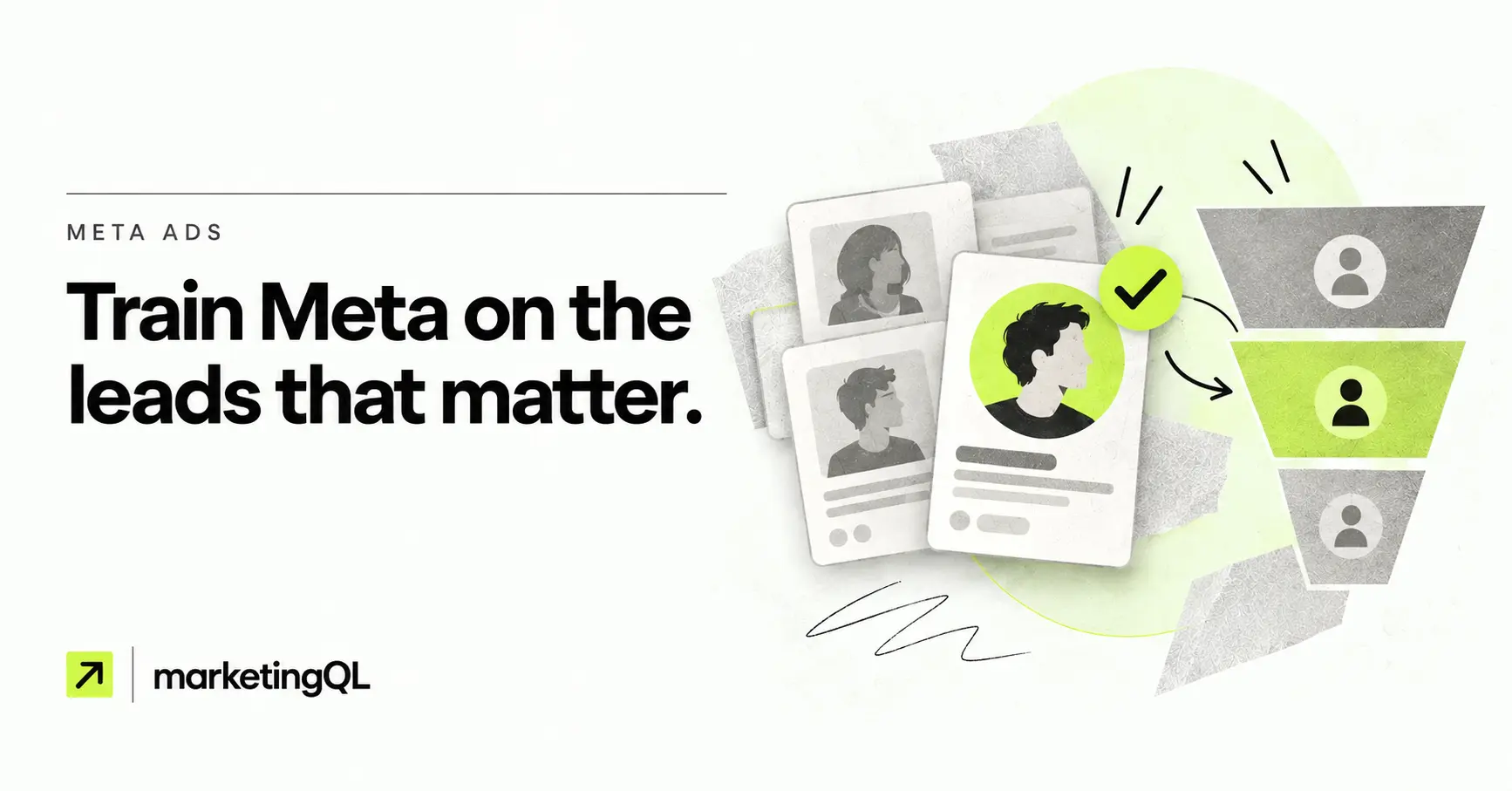
A Meta lead campaign can produce a low cost per lead and still create very little useful pipeline.
The problem is often not the dashboard. It is the signal behind the dashboard.
If Meta only receives a form submission, it can learn which people are likely to submit forms. It does not automatically know which of those people are qualified, book a meeting, or become customers.
Meta’s Conversion Leads setup is designed to close that gap. By connecting CRM outcomes through Conversions API for CRM, advertisers can send later funnel stages back to Meta and give the delivery system a clearer picture of what a useful lead looks like.
I think this is one of the more important Meta Ads features for lead-generation teams. It shifts the campaign question from “How do we get more leads?” to “How do we help the platform recognize the leads the business actually wants?”
A lead is an event, not a business outcome
A completed form is useful information. It tells us someone saw the ad, responded to the offer, and submitted their details.
It does not tell us whether the phone number works, the company fits the target customer, the person answers a follow-up, or the opportunity becomes revenue.
That distinction matters because an ad platform will optimize toward the event it can see. When every form fill looks identical, Meta has no downstream quality signal to separate a strong prospect from an irrelevant submission.
Meta’s own Blueprint training describes Conversions API for CRM as a way to connect first-party CRM data so its delivery system can optimize for lead quality instead of volume. Meta Blueprint’s Conversions API for CRM training
Lead retrieval and CRM feedback are different jobs
There are two data flows that are easy to confuse.
The first moves new leads from Meta into the CRM so the sales team can follow up. That helps operations, but it does not create a feedback loop by itself.
The second sends CRM outcomes back to Meta. That is the piece that helps the platform understand what happened after the form was submitted.
Meta’s Conversion Leads integration documentation covers both parts of that process: retrieving the lead and returning later outcomes through Conversions API. Meta’s Conversion Leads integration documentation
If leads appear in the CRM but qualified stages never return to Meta, the campaign may still be optimizing toward the easiest person to acquire rather than the most useful person to reach.
Choose one outcome the team trusts
The first setup decision is not technical. It is deciding what a qualified lead actually means.
I would start with one CRM stage that is meaningful, applied consistently, and frequent enough to produce a usable signal.
Depending on the business, that might be:
- A lead accepted by sales
- A prospect that meets agreed qualification criteria
- A meeting that was booked and attended
- An opportunity created in the CRM
- A completed quote or application step
The event should be far enough down the funnel to represent quality, but not so rare that the campaign receives almost no feedback.
Closed-won revenue may be the best business outcome. For a long sales cycle, it may arrive too slowly to be the first optimization signal. A consistently defined qualified lead or sales-accepted lead can be a better starting place.
Fix the CRM process before asking Meta to learn from it
Connecting the CRM does not make inconsistent data reliable.
If one salesperson updates lead stages every day and another leaves every record as “new,” the event being sent back will reflect the process problem.
Before using a deeper funnel event for optimization, I would check:
- Whether every new lead reaches the correct CRM record
- Whether the selected stage has one clear definition
- Whether the sales team applies it consistently
- Whether duplicate leads and test submissions are handled
- Whether the necessary identifiers are available for matching
- Whether the event is appearing correctly in Events Manager
Meta provides partner and direct integration paths for connecting CRM data. The right path depends on the CRM and the team’s technical resources, but the validation step is the same: confirm that real stage changes are arriving as the intended event. Meta’s CRM connection overview
Do not switch optimization before the signal is ready
Meta Ads can offer performance goals for leads or conversion leads, depending on the campaign setup and account availability. The important difference is what the system is being asked to find.
A standard lead goal focuses on people likely to become leads. A conversion-leads goal uses the connected downstream signal to look for people more likely to reach the selected stage. Meta’s lead ads performance-goal documentation
I would not make that change the moment the integration is connected.
First confirm that the event is accurate. Then look at how often it occurs. A highly selective stage with only a handful of events may be useful for reporting but too sparse to guide delivery reliably.
If volume is low, keep collecting the CRM signal while optimizing toward the earlier event. You can still use the downstream data to compare campaigns, audiences, forms, and creative before asking the system to optimize against it.
Test quality without changing everything else
Once the feedback loop is working, I would run a focused comparison.
Keep the offer, creative direction, form, budget, and follow-up process as consistent as possible. Compare the existing lead optimization with the conversion-leads setup.
The main metrics should move beyond the initial form:
- Cost per lead
- Lead-to-qualified-lead rate
- Cost per qualified lead
- Meeting or opportunity rate
- Sales acceptance and lead quality
- Revenue when the sales cycle allows it
A higher cost per form submission can still be a better result if a larger share of those submissions becomes qualified.
For example, one campaign may generate twice as many leads at half the CPL. If the sales team rejects nearly all of them, the cheaper campaign is not necessarily the winner.
The form and follow-up still matter
CRM feedback gives Meta a better signal. It does not repair a weak offer, confusing creative, or slow follow-up.
I would still review the full path:
- Does the ad make the offer clear?
- Does the form collect enough information to support qualification?
- Is there unnecessary friction that suppresses good leads?
- How quickly does the team follow up?
- What happens between the form submission and the qualified stage?
If lead quality is poor, the answer may involve the targeting signal, the form, the message, or the sales process. The CRM connection helps make that diagnosis more useful because the campaign can be evaluated against what happened next.
A practical starting setup
My starting approach would be:
- Define one qualified-lead stage that sales and marketing both understand.
- Confirm that the stage is recorded consistently in the CRM.
- Connect the CRM and send that outcome back through Conversions API for CRM.
- Validate the event in Events Manager before using it for optimization.
- Check whether the event has enough recent volume to support a conversion-leads test.
- Keep the offer and creative stable while comparing the two optimization approaches.
- Judge the result on cost per qualified lead and downstream outcomes, not CPL alone.
Meta can only learn from the signal you give it.
If the campaign is being judged on lead quality, the platform should eventually receive a lead-quality event. Build that feedback loop carefully, start with a stage the team trusts, and check whether it improves the outcomes that matter after the form is submitted.